Composting helps reduce waste and contributes to environmental sustainability. Since food and other compostable materials make up 20% of waste at the landfill, compost offers the best alternative for handling organic waste. It also helps in reducing the Greenhouse Gas produced when organic waste is dumped at landfills. Composting the waste also reduces pressure on city council or responsible organizations for acquiring land used for landfilling.
What is Compost?
Compost is a decomposed organic material that can be used to improve soil’s physical, chemical, and biological properties. Compost is rich in plant nutrients and beneficial organisms like bacteria, protozoa, nematodes and fungi which improves soil fertility in gardens, landscaping, horticulture, urban agriculture and organic farming thus reduces dependency on commercial chemical fertilizers.
A compost is made by decomposing a mix of green waste (nitrogen-rich materials such as leaves, grass, and food scraps) and brown waste (woody materials rich in carbon such as stalks, paper, and wood chips). Generally, it takes approximately six to nine months before the compost is ready for use. The length of time taken for the compost to be ready depends on whether the compost has adequate amount of water and right size of wood chips, and how often the materials are turned for aeration.
Deciding on your composting method
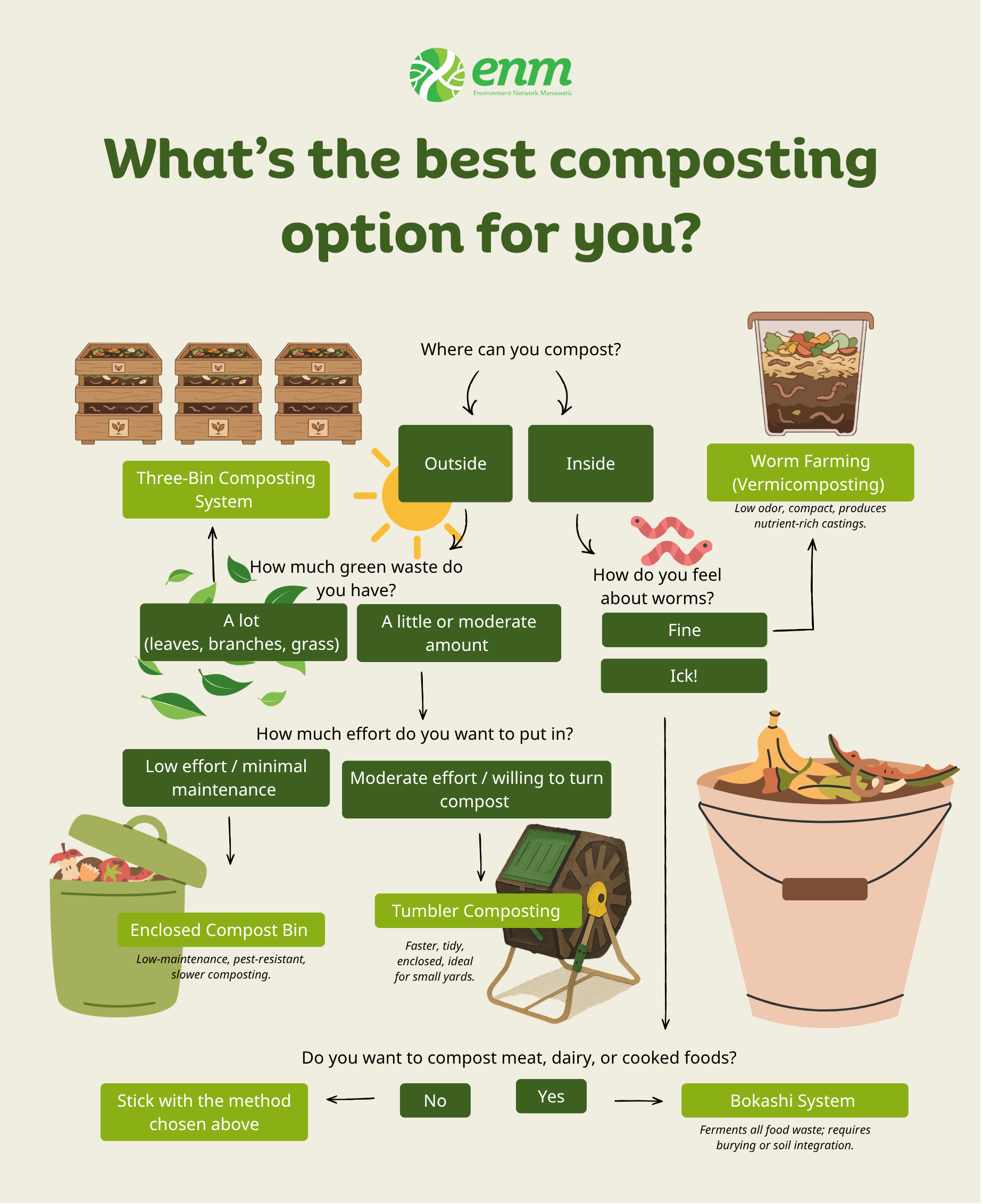
Information about each option
Green and brown matter
|
Green (Nitrogen Rich, Wet) |
Brown (Carbon rich, dry) |
|
Fruit scraps |
Dry leaves |
|
Vegetable scraps |
Straw |
|
Coffee grounds |
Hay (old and dry) |
|
Tea Leaves |
Pine needles |
|
Spoiled produce |
Cornstalks |
|
Fresh grass clippings |
Untreated sawdust |
|
Fresh Leaves |
Wood chips |
|
Garden Trimmings |
Tree Barks |
|
Weeds without seeds |
Shredded newspaper |
|
Plant stems and green branches |
Shredded cardboard |
|
Fresh flowers |
Paper towels |
|
Seaweed |
Paper bags |
|
Brewery Waste |
Toilet Paper rolls |
|
|
Egg cartoons |
|
|
Vacuum Cleaner dust |
|
|
Natural fiber fabrics (cotton, linen, wool) |
|
|
Nut shells |
|
|
Egg shells |
|
|
Twigs and sticks |
|
|
Wood Ash |
What not to compost
Although in theory anything organic can be composted, some things are best avoided when composting at home.
|
Material |
Reason |
|
Cat and dog faeces |
Can cause disease |
|
Meat, fish, oil, bones, fat |
Can attract rats |
|
Non-organics e.g. tin, glass, plastics |
Won’t break down |
|
Invasive weeds, e.g. kikuyu, wandering willy, jasmine |
Could spread in or beyond your garden – however they can be composted after treatment. |
|
Large amounts of pine needles or gum leaves |
Allopathic - create environment hostile to compost creatures |
|
Woody materials in pieces larger than the diameter of your finger |
Too slow to break down
|
|
Diseased plants (e.g. with blight) |
Disease may spread |
|
Bamboo, flax and cabbage tree leaves |
Not suitable for composting and not taken by composting companies (bury in the ground, or take to a resource recovery center for landfilling) |
To take note!
Plants like honeysuckle and Mexican daisy are considered pests therefore controlling them is essential. Species such as ginger, jasmine, and privet can cause serious damage to our native environment. Pre-composting practice is essential for composting invasive weeds. These can be done by:
- Put the weeds in a large plastic bag with a handful of soil and water.
- Tie the top and leave for at least two months, until there are no green shoots or other signs of life.
- Add them to your compost heap as green.
Common Composting problem
In general, all composting practices have problems faced when doing them. The table below is a summary of the common problems in all practices.
|
Problem |
Cause |
Solution |
|
Smelly, slimy heap
|
Not enough air |
Turn heap |
|
Too wet |
Add brown material (e.g. dry leaves) |
|
|
Too much nitrogen |
Add brown material |
|
|
Materials are not decomposing |
Heap too small |
Increase size of heap |
|
Not enough heat due to lack of green materials or water |
Add green materials
|
|
|
Materials in heap are too large |
Break materials down into small pieces |
|
|
Pests attracted to heap e.g. flies, cockroaches, rats, mice |
Wrong food added |
Don’t use meat/bones/fish Bury food scraps in center of heap |
|
Bin not rodent proof |
Rodent proof your bin |
|
|
Fruit flies (vinegar flies) |
Heap is too acidic |
Sprinkle lime on heap |
|
Ants |
Heap is too dry |
Add water and lime |
 ENM on Facebook